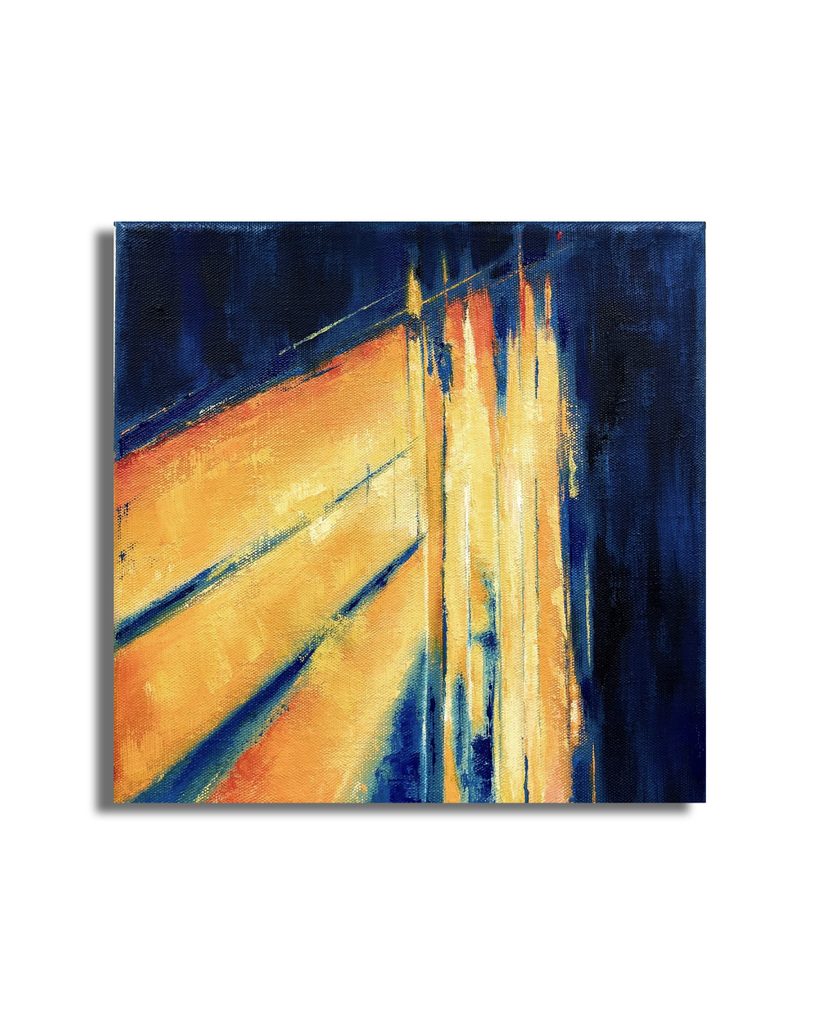
Materials: Canvas
Dimensions: 30 x 30 cm
Available
Price upon request
From the “After the Light” series.
When does silence become language?
Is it possible to give form to something that has no voice?
And can something be perceived even when it cannot be directly seen?
After the Light emerges from these questions.
Light, like silence, has no inherent form of its own. Yet we can recognize it through
what happens when it moves through space: when it meets a surface, when it
reflects, when it disperses.
Long-exposure photography makes visible something that normally escapes the
image: duration. An instant is no longer recorded as a fixed point, but as an interval.
Movement accumulates, light extends, and time becomes visible.
This possibility is where the triptych begins.
The works don’t attempt to reproduce the photographs from which they originate.
Painting retains only their underlying principle and transforms it. Light moves from
the precision of the image into matter, from movement into surface, from form into perception.
In the first painting, a direction can still be recognized.
In the second, that direction opens and multiplies.
In the third, the form progressively loses its boundary.
Light is therefore not represented as an object to be observed, but as a phenomenon
to be perceived.
And silence follows the same principle: it isn’t necessarily emptiness. It can be an
interval, a tension, a form of listening. It can exist between two words, between two
moments, between what is perceived and what hasn’t yet found a name.
Perhaps silence becomes language when it communicates not through a voice, but
through what it alters within us.
After the Light doesn’t attempt to show what cannot be seen.
It questions what remains within perception when form is no longer enough.
Light enters the space as an event.
It isn’t yet atmosphere, nor reflection: it is the moment in which an encounter takes place.
A beam crosses the darkness and, meeting a surface, becomes perceptible. Its
presence depends not only on its source, but on the interaction between light, space,
and matter.
Incidence emerges from this first moment.
The composition still preserves a recognizable direction: light crosses the field of
vision, concentrates, fragments. The vertical and diagonal forms don’t describe a
specific place, but register the passage of something that cannot be directly
observed.
Painting intervenes precisely where photography is no longer enough.
Soft surfaces are interrupted by the materiality of the palette knife; lines overlap,
break, and re-emerge. Light is no longer merely an optical effect, but becomes
surface, gesture, pigment.
It is the moment in which light becomes visible because it encounters something.
Perhaps silence works in the same way.
It doesn’t need to be spoken to be perceived. It can manifest itself in the tension of a space, in the interruption of a
sentence, in the sudden presence of something left unsaid.
Incidence is the moment of encounter: what we cannot see becomes perceptible
through what it alters.