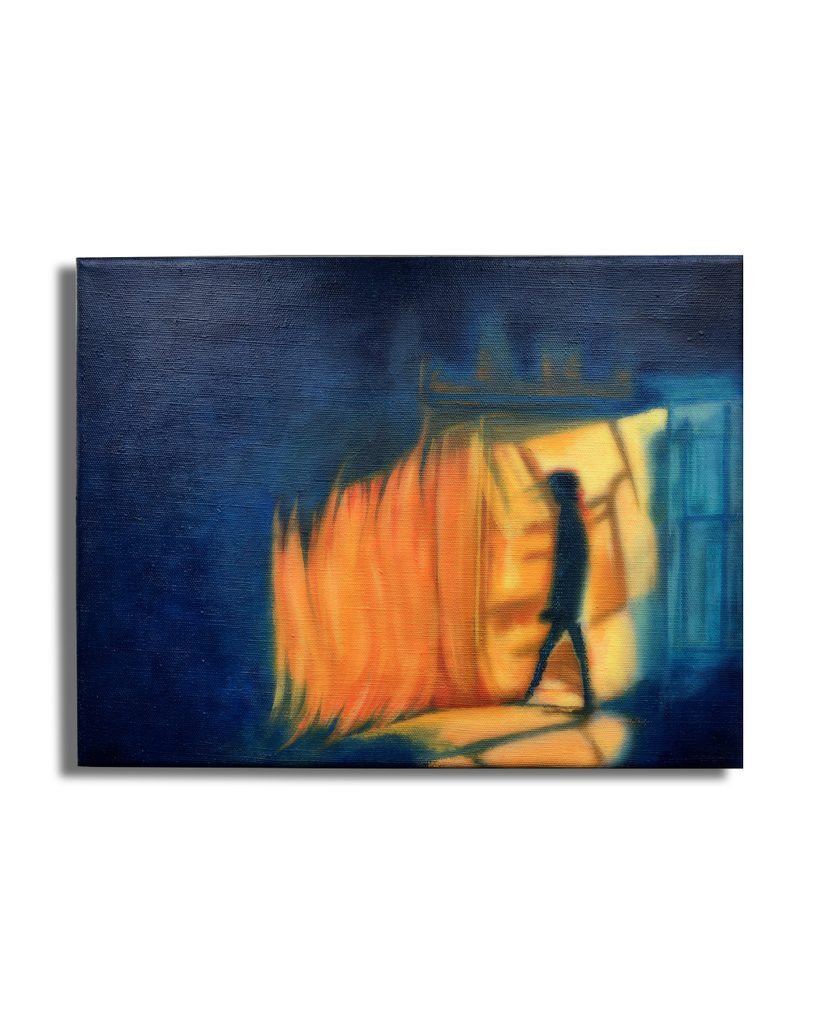
Materials: Canvas
Dimensions: 30 x 40 cm
Available
Price upon request
From the “What Persists” series.
When does a trace cease to belong to what gave rise to it?
Can we lose someone who continues to transform us?
What Persists emerges from the intersection of these two questions.
Every presence alters the space it moves through. Some traces dissolve; others
continue to act even when what gave rise to them is no longer visible. Over time,
what once belonged to a person, a place, or an experience can transform into
something autonomous, eventually becoming part of a reality different from the one
in which it originated.
The triptych explores this transformation through the relationship between figure,
architecture, and light. The spaces don’t define specific places, but conditions in
which presence can emerge, lose its substance, and leave an imprint. The structures
remain recognisable, while their boundaries shift and light seems to
preserve something of what has passed through them.
Long exposure becomes a painterly principle through which the passage of time is
made visible. Figures dissolve, contours break apart, and movement translates into a
luminous trace. What remains isn’t an immobile testimony of the past, but a process
still unfolding: something that continues to alter the space even after it has moved
beyond its centre.
What Persists doesn’t seek to represent memory or give form to absence. It focuses
on what survives its own origin, transforming and taking on new forms.
Perhaps a presence doesn’t end when it disappears, but when it ceases to produce
effects. Until then, something continues to propagate, leaving traces we aren’t
always able to recognise.
Every transformation begins when something crosses a Threshold.
A figure moves through an architectural space, immersed in light that progressively
alters the boundaries between the body and its surroundings.
The threshold doesn’t necessarily mark a separation. It is the point at which a
presence begins to change its relationship with the space that has contained it. The
architecture retains its structure, while the body loses its substance and its
movement remains imprinted in the light.
What passes through space doesn’t simply disappear: it leaves something of itself
behind in the place it moves away from.