Materials: Canvas
Dimensions: 50 x 60 cm
Available
Price upon request
From the “A Place Without Goodbye” series.
The myth of Orpheus and Eurydice has been told for centuries as a story of
love and loss. Orpheus descends into the Underworld to bring Eurydice back
to the world of the living and is allowed to lead her out on one condition: he
mustn’t turn to look at her until they have reached the light.
But the moment Orpheus turns, Eurydice disappears once again.
The myth ends there.
We don’t know what Eurydice thought. We don’t know what she felt as she
followed someone she couldn’t see, or what it meant for her to realize that the
return wouldn’t be possible.
It is from this untold space that A Place Without Goodbye emerges.
The triptych doesn’t seek to rewrite the myth, nor simply to depict its tragedy.
Instead, it uses it as a starting point to question something more universal:
what happens to a bond when the presence of another can no longer be taken for granted?
The project also enters into dialogue with To Love A Thing That Fades by
Vincent Lima, which moves through the myth of Orpheus and Eurydice as a
reflection on grief, memory, and the impossibility of holding on to what
inevitably fades.
If Lima follows Orpheus’s journey, these works choose to remain beside Eurydice.
Not at the moment of death, but at the moment when a presence begins to transform into absence.
The myth thus becomes a reflection on bonds in a broader sense: on
affection, trust, loss, and the transformations that occur when something or
someone can no longer remain in the form we once knew.
A bond can change shape. A person can disappear from our lives. A
relationship can end, transform, or become distance. And yet, what has been
experienced can continue to exist through memory, through the traces it
leaves behind, through the way it alters our perception of ourselves and the world.
Perhaps the value of a presence doesn’t depend on its ability to remain.
Perhaps what continues to live isn’t the presence itself, but the transformation it has left within us.
And so Eurydice isn’t only the one who is lost, but she is also the one who remains.
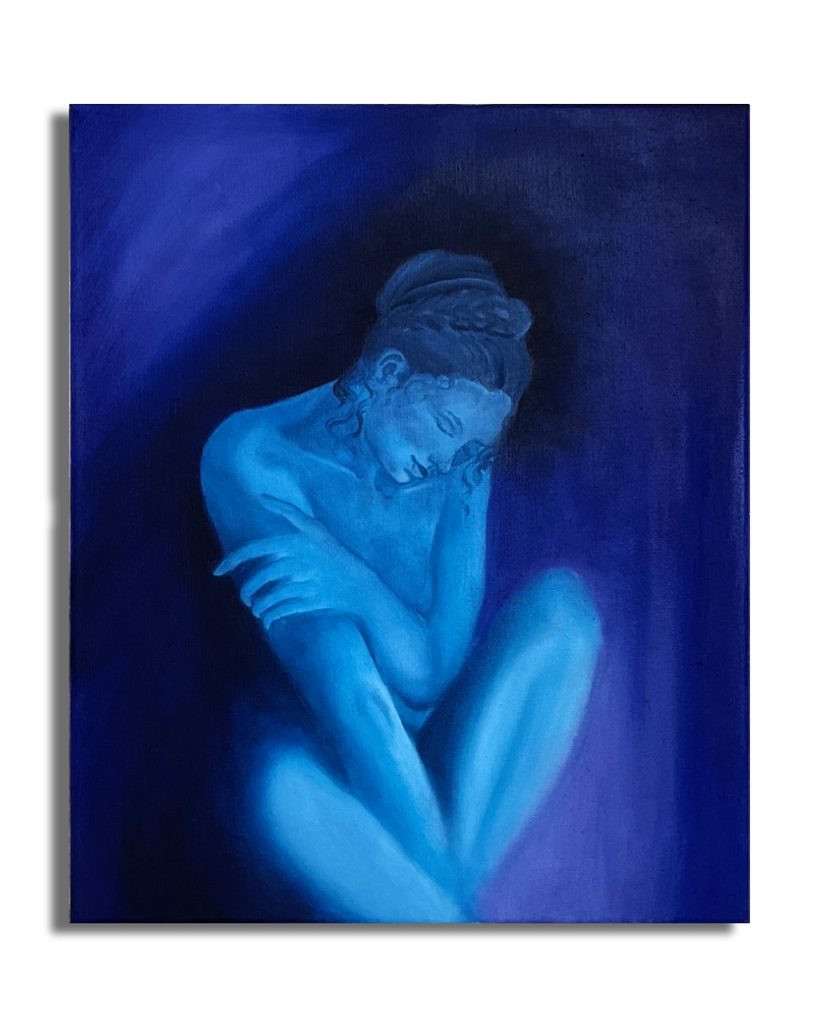
I Remain doesn’t represent Eurydice’s second death, but it represents
what comes after.
The body folds inward, not as an act of surrender, but as a return towards
itself. What has happened cannot be erased, yet it cannot be restored to its
original form either.
I Remain emerges from a question: what remains of us when something
that once defined us can no longer be held?
Perhaps what remains are the traces, memory, the way someone continues
to shape our gaze even after they have gone.
Loss doesn’t necessarily erase what once existed, sometimes, it transforms it.